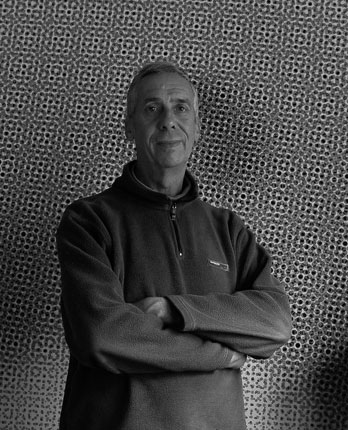
Daniel Airam

Born in 1958 in Lyon

Lives and works in the Alpes-Maritimes

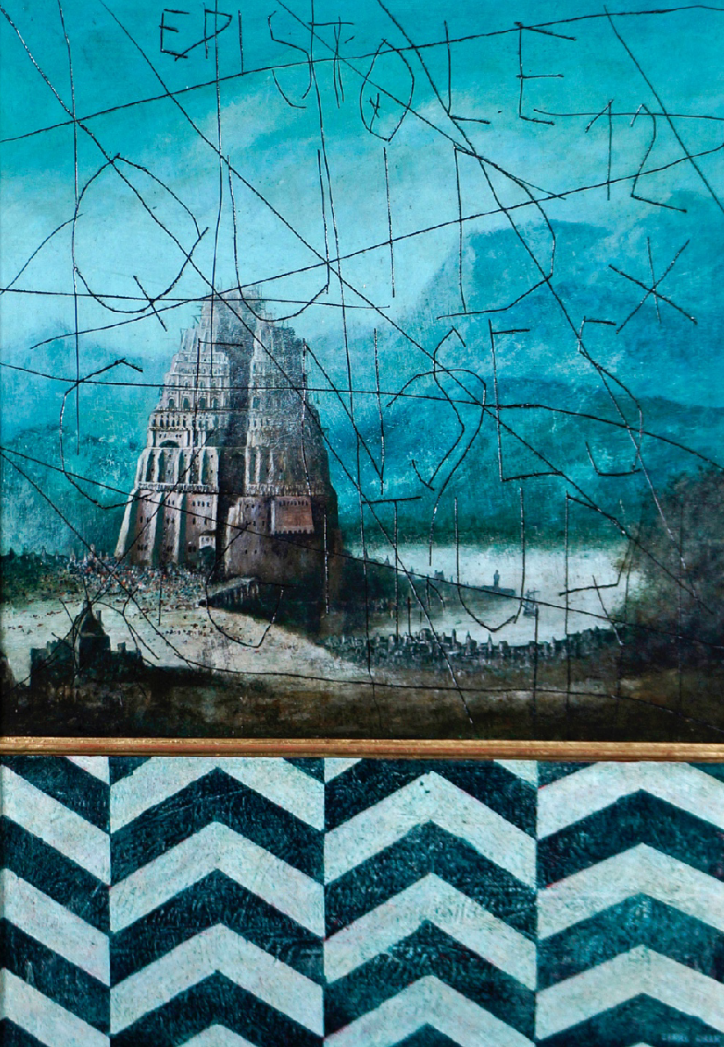
If the persistence of the practice of incised graffiti -most often carved into wall plaster or tree bark-never ceases to surprise me, the immutable beauty of Flemish portraiture and its ocean of faces enchants me just as deeply. Beyond the suggested irony, it becomes clear that what unites them belongs to the same register: that of countless anonymous existences, each generating an equal delight in its own singularity. Both emerge from a quasi-mechanical, codified system, endlessly repeated, yet their extraordinary presence endures through time. While one openly claims its popular nature and the other its belonging to an assumed aristocracy, it is striking to observe that a shared memorial function brings them together as a common point of reference.

By openly embracing the idea of an art history at the heart of my artistic practice, the use of varnish imposed itself naturally, bringing brilliance and hardness to the paint. It echoes the famous “radiance” spoken of by Van Eyck -an éclat close to glass, to stained glass, and also to an epidermis meant to protect an organic and fragile world.

Painting is a hermetic chamber in which a succession of singular interventions unfolds: contradictory choices and fortunate hesitations struggle and coexist.

In the vertigo of a world where everything wavers, where no reliable model remains, will the image still oppose its capacity to dazzle -its power to be -in order finally to exist as it conceives itself?

Such is the foundation of my work. Parietal art -this so-called cave art-remains, in my eyes, the most powerful encounter. Perhaps because of the silence that surrounds it, a silence that renders any explanation impossible.

To see, to look, to observe, to admire.

JUBILANT DICHOTOMY

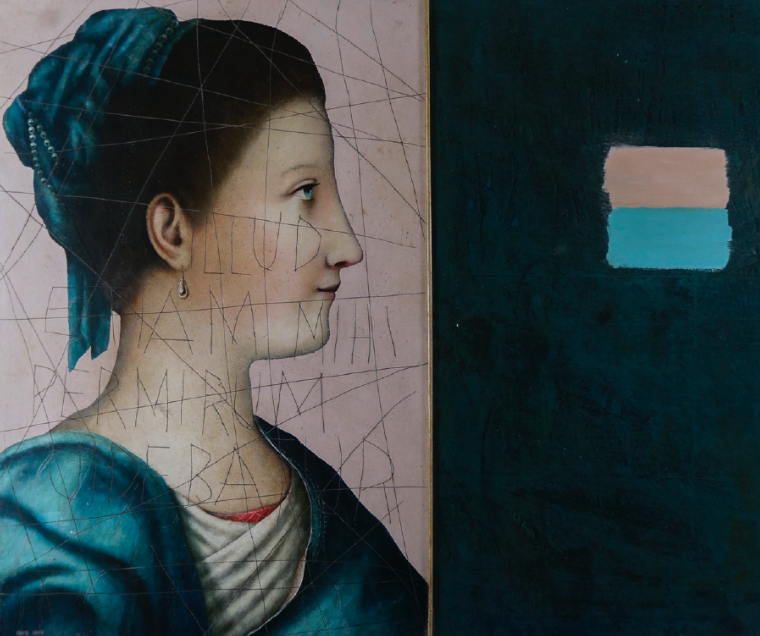
Daniel Airam’s painting is doubly fascinating. On one hand, it offers a figuration imbued with the quintessence of ancient art, particularly Flemish art from the 15th to 17th centuries. The homage is overt, and the beauty of the portraits exudes an incredible modernity. On the other hand, it engages in a vertiginously contemporary approach through scarifications, graffiti, and engraved words that play with our emotions and prompt us to question not only the passage of time (the artwork seems to have lived) but also humanity’s delirious propensity to leave its mark on everything it touches—from a simple tree trunk to the most renowned monuments.

“The persistence of the practice of graffiti, most often etched into the plaster of a wall or the bark of a tree, never ceases to amaze me, just as the timeless beauty of Flemish portraiture and its ocean of faces continues to enchant me,” the artist explains, adding: “With irony suggested, it is worth noting that what unites them stems from the same realm: a vast collection of anonymous lives, each secreting an equal delight in their singularity.”

A curious anecdote of our time: as I write these lines, a guard at the Boris Yeltsin Art Center in Ekaterinburg, Russia, has had his fifteen minutes of fame after being accused of scribbling ‘eyes’ onto a painting by Anna Leporskaya (1900–1982), entitled The Three Figures, completed in 1934 and valued at €880,000. Here, reality meets fiction, in a way.

Through this delightful dichotomy (portrait and graffiti), rooted at the very heart of representation, Daniel Airam breathes new life into so-called classical painting, incorporating it into a resolutely temporal perspective and adding a sort of “lees” that might be conceived, in some ways, as “the angels’ share” of time—a kind of “baroque” residue made of signs and words. Daniel Airam’s painting is at once heritage and pure creation.

Upon closer examination, the words he inscribes at the heart of his paintings, like a sort of frontispiece, are Latin terms: pactum, solarius, operte, consonus, etc. These words resonate like subliminal messages meant to add an extra layer of mystery—or lightness, as one might prefer. Here, painting holds the power to both intrigue and dazzle.

The artist’s credo, “To see, to look, to observe, to admire,” aligns perfectly with this atypical figuration, to which varnish adds brilliance and hardness, giving it, as Daniel Airam himself says, that famous “sheen” Van Eyck spoke of—this sheen akin to glass, stained glass, or an epidermis designed to protect a fragile, organic world.

Miroir de l’Art #115

Daniel Airam

List of Exhibitions

Expositions 2023 – 2018 Expositions 2017 – 1998
2023
Antica Namur Art Fair, solo show, galerie “Au-delà des apparences”
Lausanne Art Fair, Bel Air Fine Art Galerie
CONTEXT Art Miami, Bel Air Fine Art Galerie
Moderne Art Fair Paris, Bel Air Fine Art Galerie
Réalisation d’une collection textile par Artist Le Studio BF à partir du tableau « Didon et Enée »
Art’up Lille, solo show, galerie au-delà des apparences2022
Art’up Lille, solo show, galerie au-delà des apparences
Art Montpellier, galerie au-delà des apparences (c)
Galerie au-delà des apparences (p)
Notre mer, Saint Laurent d’Agny (c)

2021
Art’up Lille, galerie au-delà des apparences (c)
Art Montpellier, galerie au-delà des apparences (c)

2020
Art Montpellier, galerie au-delà des apparences

2019
Art’up Lille, galerie Patrick Bartoli (c)
Voies/voix, SCOF Grigny (c)
Hommage à Auguste Renoir, Cagnes-sur-Mer (c)

2018
Art’up Lille, galerie Patrick Bartoli (c)
« Hors direction » librairie niçoise, Nice (c)
Galerie au-delà des apparences, Annecy (c)
Grève blanche, galerie Licence IV, Lyon (c)
Château de la Tour de l’Évêque, Pierrefeu (c)
« Voyage d’hiver », SCOF Grigny (c)

2017
Galerie Patrick Bartoli, Marseille (p)2016
Galerie Arnaud Bard, Boulogne (p)

2012
Harper Dejong, Londres, UK

2011
Galerie art4art, Zurich, Suisse
Secret Art Gallery, Londres, UK

2010
Galerie Phillipe Paschos, Grimaud, France
Galerie de la ville de Beausoleil, France

2006
Galerie Phillipe Paschos, Grimaud, France
Galerie IEM, Antibes, France

2001
Galerie Breheret, Paris, France

2000
Galerie Marlies Hanstein, Saarbrucken, Allemagne

1999
st’art 99, Galerie Philippe Paschos, Strasbourg, France

1998
Galerie Michelle Broutta, Paris, France

Participe à de nombreuses expositions collectives en France, Europe, États-Unis, Japon.